- Place brisket cold on a large cutting board. Identify the flat (leaner) and the point
(thicker, fattier). - Trim the fat cap to about 1/4 inch. Too thick blocks seasoning and prevents proper bark formation.
- Remove hard, waxy fat (it won’t render well) especially between point and flat.
- Square up thin edges if they’re extremely skinny (thin flaps can dry out). Don’t over-trim—just clean it up.
2) Season like Texas
- Optional: lightly coat brisket with mustard/hot sauce as a binder.
- Mix salt and pepper. Season brisket generously on all sides, especially the top and edges.
You want a visible peppery layer, not a light dusting. - Rest brisket at room temperature 30–45 minutes while you heat the smoker (or refrigerate 4–12 hours for a “dry brine”).
3) Preheat smoker
- Set smoker to 225–250°F (107–121°C). Most backyard setups do great at 250°F for a slightly shorter cook.
- Add wood and allow clean smoke (thin and bluish). Thick white smoke can taste bitter.
- If you use a water pan, fill it (optional). It can help stabilize temps and keep edges from drying.
4) Smoke the brisket (build bark slowly)
- Place brisket on smoker with the thicker point toward the hotter side. Fat cap orientation depends on your smoker:
fat toward the heat source is a good rule of thumb. - Smoke at 225–250°F until the bark is set and dark (often 4–6 hours), and internal temp is usually around
160–175°F (71–79°C). This is where the “stall” often happens. - Optional spritz: after the first 2–3 hours, spritz lightly every 45–60 minutes if the surface looks dry.
Don’t over-spritz—too much can cool the meat and slow bark formation.
5) Wrap (Texas crutch) when bark is right
- When the bark is deep brown/black and doesn’t smear when you rub a finger across it, wrap the brisket tightly in butcher
paper (preferred) or foil. - Return brisket to the smoker, seam side down, and continue cooking at 250°F.
6) Cook until probe-tender (not just a number)
- Start checking around 195°F (90°C) internal, but focus on feel:
a probe or skewer should slide in like warm butter, especially in the flat. - Most briskets finish around 200–205°F (93–96°C), but every brisket is different.
7) Rest (the step that makes or breaks brisket)
- Keep brisket wrapped and rest at least 1–2 hours. Longer is better.
A 3–4 hour rest in a warm cooler (towel-wrapped) is common for ultra-juicy slices. - If you have an oven that can hold 150–170°F (65–77°C), you can do a warm hold for several hours.
8) Slice correctly
- Separate point and flat if you want maximum control: follow the natural seam of fat between them.
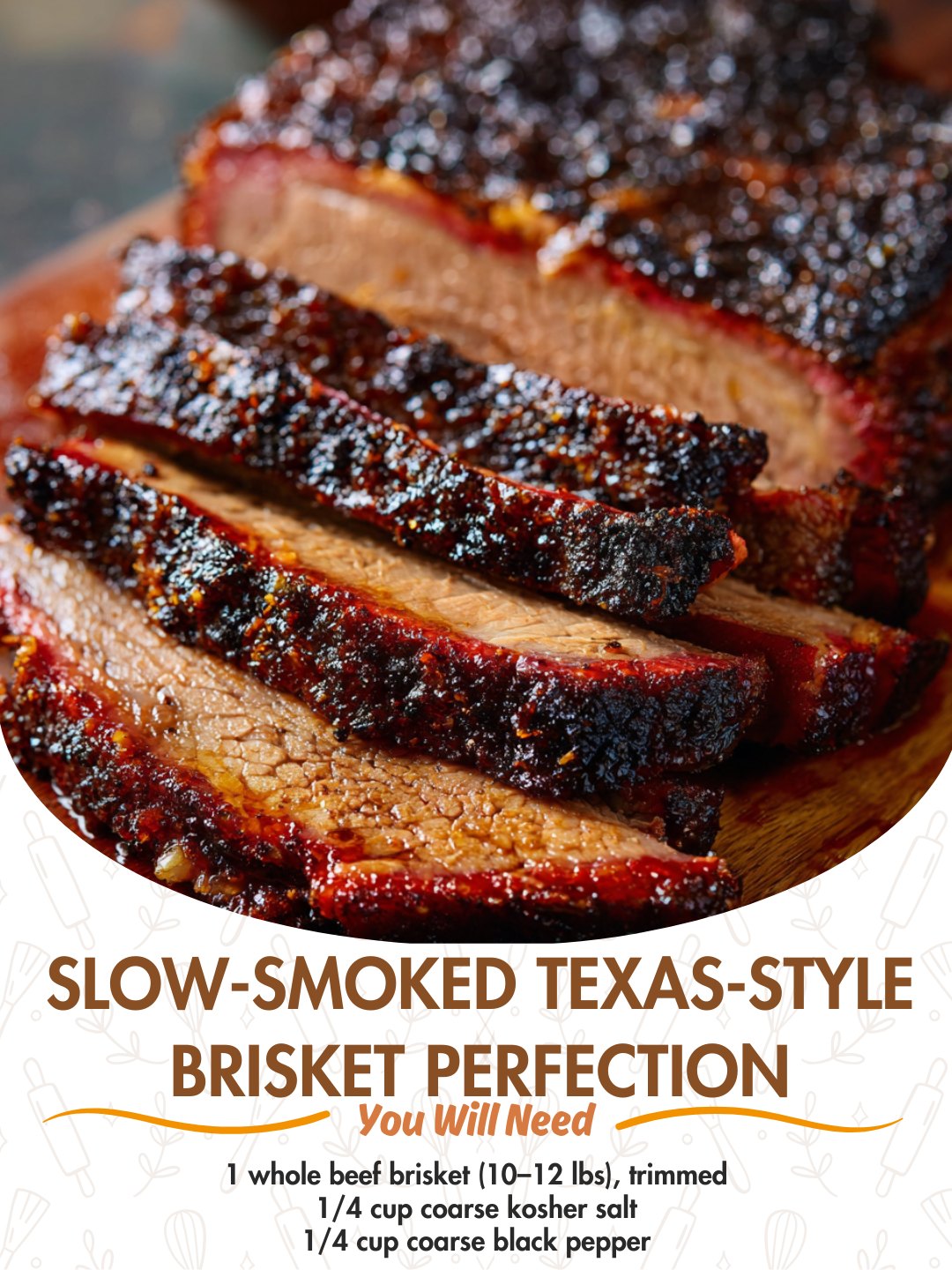
- Slice the flat against the grain into pencil-thick slices (about 1/4 inch).
- The point grain often runs differently—rotate and slice accordingly, or cube for burnt ends.
Serving and Storage:
Serve brisket with classic sides like pickles, white bread, sliced onion, and jalapeños—Texas-style. Add potato salad, slaw,
beans, or mac and cheese for a full barbecue plate.
- Refrigerate: Store leftovers in an airtight container up to 4 days.
- Freeze: Wrap tightly and freeze up to 2 months (sliced or whole chunks).
- Reheat: Best method is low and gentle: wrap with a splash of broth/tallow and warm at
275°F (135°C) until hot. Avoid high heat (dries it out).
Tips:
- Buy a whole packer: It’s more forgiving than flat-only brisket and stays juicier.
- Trim for airflow: Smooth edges and a 1/4-inch fat cap help cook evenly and build bark.
- Chase “clean smoke”: Thin blue smoke tastes best. Bitter smoke ruins great brisket fast.
- Wrap when the bark is set: Wrapping too early makes bark soft and muddy.
- Rest longer than you think: Resting is where brisket becomes juicy instead of “dry but tender.”
Variations:
- Goldee’s-inspired (simple upgrade): add a touch of Lawry’s seasoned salt to the rub (still very Texas).
- Burnt ends: cube the point, toss with a little rub and sauce (optional), and smoke 45–90 minutes more.
- No-wrap method: smoke unwrapped the entire time for maximum bark—expect a longer cook and manage dryness
with careful temp control. - Hot-and-fast: cook at 275–300°F for a shorter cook time. Still rest long, and wrap once bark is set.
- Pellet grill method: use a smoke tube or lower temps early for more smoke flavor, then finish at 250°F.
Tips:
- Time guide: Roughly 1–1.5 hours per pound at 225–250°F, but brisket is done when it’s probe-tender.
- Protect the flat: If the flat feels like it’s cooking too fast, orient it away from the hottest spot.
- Slice only what you need: Keep the rest intact and wrapped to stay moist.
- Don’t press the brisket: Squeezing “to see juices” just squeezes moisture out.
Conclusion:
Slow-smoked Texas-style brisket is a craft, but it’s absolutely achievable at home when you focus on the fundamentals:
a clean trim, a simple salt-and-pepper rub, steady heat, patient bark-building, smart wrapping, and a long rest. Master those
steps and you’ll get the reward every pitmaster chases—juicy slices, smoky beef flavor, and a bark that cracks when you bite.
Make it once with intention, take notes, and your brisket will get better every time you smoke one.
FAQ:
What temperature should I smoke brisket at?
225–250°F (107–121°C) is classic. Many home cooks use 250°F for a slightly shorter cook with great results.
When should I wrap brisket?
Wrap when the bark is dark and set (it doesn’t smear) and the internal temp is often around 160–175°F (71–79°C).
What internal temperature is brisket done?
Usually 200–205°F (93–96°C), but the real test is probe-tender feel—your probe should slide in easily, especially in the flat.
Why is my brisket dry?
Common causes are overcooking the flat, slicing with the grain, or not resting long enough. A long rest and correct slicing
make a huge difference.
Should I slice the point and flat differently?
Yes. The grain direction changes. Slice the flat against the grain; rotate or separate the point and slice it against its
grain (or cube it for burnt ends).