
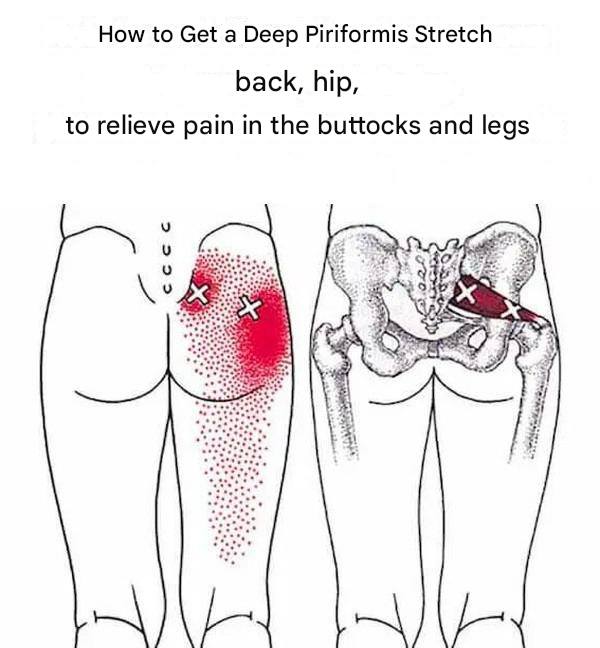
What the Piriformis Does and Why It Hurts
The piriformis helps rotate the hip and stabilize the pelvis when you walk, climb stairs, or shift your weight. When it becomes tight or inflamed, it can compress the sciatic nerve in a condition often called piriformis syndrome, leading to pain or tingling in the buttock and along the back of the leg that can mimic sciatica from a spinal disc problem. Prolonged sitting, sudden increases in activity, muscle imbalances, and a lack of hip mobility all increase stress on this muscle and can trigger symptoms.
General Safety Before You Stretch
-
Warm up first with 5–10 minutes of light movement such as walking, easy cycling, or marching in place to increase blood flow to the hips.
-
Stretch only to a comfortable pulling sensation, not sharp or worsening pain; if symptoms shoot down the leg or you feel numbness, stop and seek medical advice.
-
Move slowly and avoid bouncing; held stretches are usually kept for 20–30 seconds and repeated 2–4 times per side, 1–2 times daily as tolerated.
Key Deep Piriformis Stretches
1. Figure‑4 (Supine Piriformis Stretch)
This is one of the most commonly recommended stretches because it’s simple and effective.
-
Lie on your back with both knees bent and feet flat.
-
Cross your right ankle over your left knee so your legs form a “figure‑4.”
-
Reach your hands behind the left thigh and gently pull the leg toward your chest until you feel a deep stretch in the right buttock/outer hip.
-
Hold 20–30 seconds, breathing steadily, then switch sides; repeat 2–4 times per leg.
To deepen the stretch, you can gently press the right knee away from you with your hand while keeping the ankle crossed, but avoid forcing the joint if you have knee issues.
2. Seated Piriformis Stretch
This is useful if you sit a lot or want a desk‑friendly option.
-
Sit upright on a chair with both feet flat on the floor.
-
Place your right ankle on top of your left knee.
-
Keeping your back straight, hinge forward at the hips and lean your chest toward your right shin until you feel a stretch in the right buttock.
-
Hold 20–30 seconds, then return upright and change sides; repeat several times.
If you feel strain in the lower back rather than the hip, sit taller, hinge less, and focus on rotating from the hip joint rather than rounding the spine.
3. Knee‑Across‑Body (Supine Cross‑Body Stretch)
This targets the piriformis through hip adduction and rotation.
-
Lie on your back with legs straight.
-
Bend the right knee and bring it toward your chest.
-
Using your left hand, gently pull the right knee across your body toward the left shoulder, keeping both shoulders on the floor.
-
Stop when you feel a strong but tolerable stretch in the right buttock and outer hip, not the low back. Hold 20–30 seconds, then repeat on the other side 2–4 times.
You can slightly adjust the knee angle (more toward the chest or more across the body) to find the position that most effectively targets your tight area.
4. Advanced “Pigeon‑Style” Hip Stretch
This is deeper and should be used only if you already have reasonable hip mobility.
-
Start on hands and knees.
-
Bring your right knee toward your right wrist and angle your lower leg so the right foot moves toward the left side of the mat (shin roughly across your body).
-
Extend the left leg straight back, keeping hips as level as comfortable.
-
Gently lower your torso toward the floor, supporting your weight with your hands or forearms until you feel a strong stretch in the right glute/piriformis.
-
Hold 20–30 seconds, then carefully come out and switch sides.
ADVERTISEMENT
