
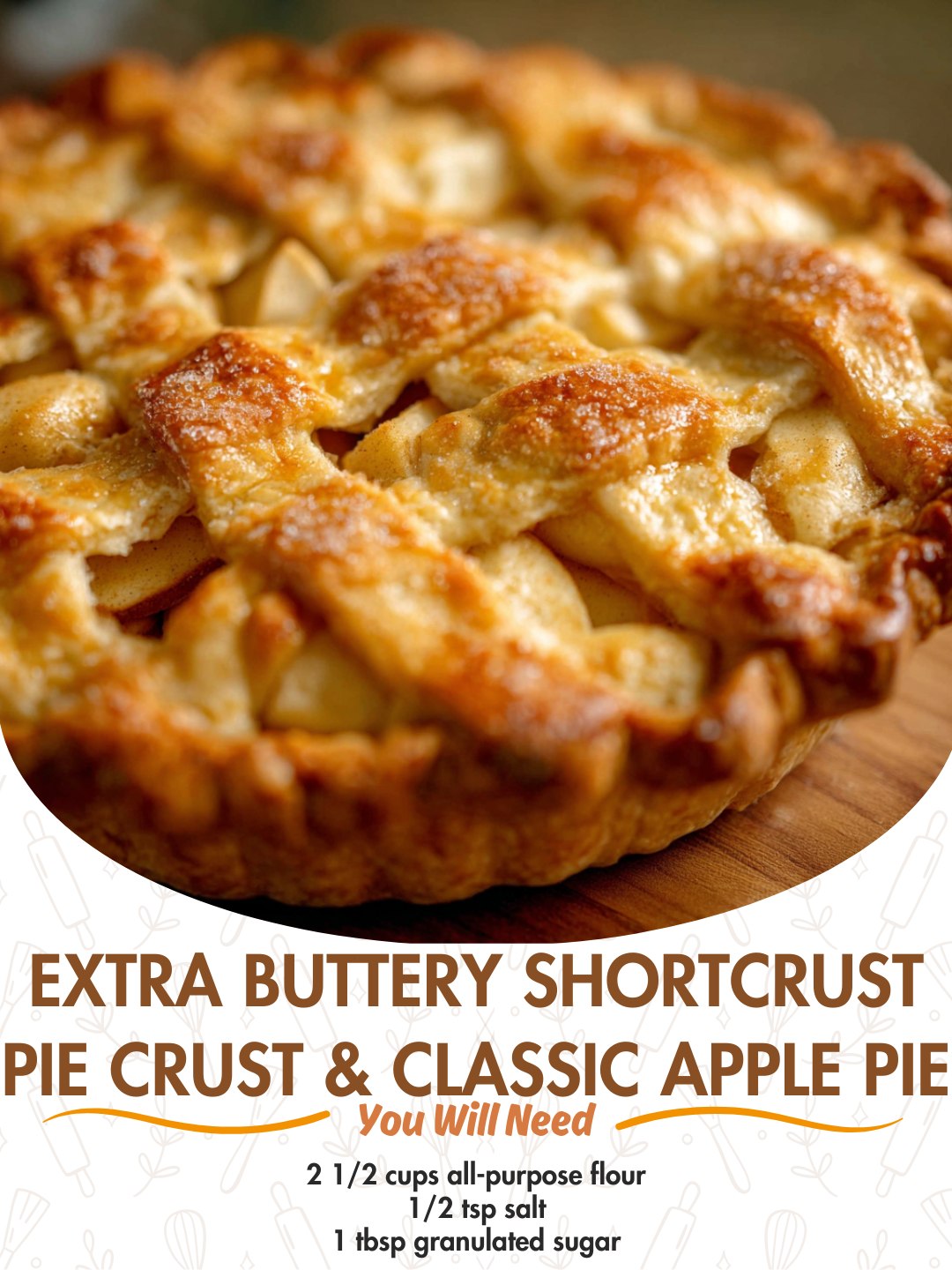
Part A: Make the Extra-Buttery Shortcrust (Double Crust)
Step 1: Chill everything
Cold is your best friend. Place butter in the fridge (or freezer for 10 minutes), and keep a small glass of water with ice ready.
If your kitchen is warm, chill the mixing bowl too.
Step 2: Mix dry ingredients
In a large bowl, whisk together flour, salt, and sugar. Even distribution helps the crust bake evenly and taste balanced.
Step 3: Cut in the butter
Add cold butter cubes to the flour mixture. Use your fingertips or a pastry cutter to work the butter into the flour until you have a
mix of sizes: some pieces like peas, some like small flakes. Those butter pieces create layers and flakiness.
Step 4: Add ice water gradually
Drizzle in ice water 1 tablespoon at a time, tossing with a fork. Stop as soon as the dough holds together when you pinch it.
It should look shaggy, not smooth. If using vinegar, mix it into your first tablespoon of water.
Step 5: Divide and chill
Turn the dough onto a lightly floured surface and bring it together gently—do not knead. Divide into two equal portions and form each
into a disk. Wrap tightly and chill for at least 1 hour (or up to 2 days). This relaxes gluten and firms the butter.
Part B: Prepare the Classic Apple Pie Filling
Step 1: Slice apples evenly
Peel, core, and slice apples into even slices (about 5–7 mm / 1/4 inch). Even slices cook evenly, preventing mushy pieces and hard pieces.
Step 2: Season and thicken
In a large bowl, toss apples with granulated sugar, brown sugar, cinnamon, nutmeg (if using), salt, lemon juice, and vanilla (if using).
Sprinkle in cornstarch and toss until the apples look evenly coated.
Optional (for a less watery pie): Let the apples sit for 20 minutes, then pour off excess juice into a small saucepan
and simmer it for 3–5 minutes to reduce. Pour the reduced syrup back over the apples. This concentrates flavor and improves sliceability.
Part C: Roll, Assemble, and Bake
Step 1: Roll the bottom crust
Preheat oven to 220°C / 425°F. Roll one chilled dough disk into a circle about 30–33 cm (12–13 inches) wide.
Transfer to a 9-inch pie dish, letting the excess hang over the edges. Chill the lined dish while you roll the top crust.
Step 2: Add filling
Spoon the apples into the crust, mounding slightly in the center. Dot the top with diced butter. Don’t pack the apples too tightly;
they need room to settle as they bake.
Step 3: Add the top crust
Roll the second dough disk into a similar circle. Place it over the apples, or cut into strips for a lattice. Trim excess dough,
then fold the edges under and crimp. Cut 4–6 slits in a solid top crust for venting (very important to release steam).
Step 4: Egg wash and sugar
Whisk egg with 1 tablespoon milk or water. Brush over the top crust for shine and browning. Sprinkle with coarse sugar if desired.
Step 5: Bake
Bake at 220°C / 425°F for 15 minutes, then reduce to 190°C / 375°F and continue baking
for 35–50 minutes, until the crust is deep golden and the filling is bubbling (you should see bubbling near the center,
not only at the edges).
If the edges brown too fast, cover the rim with foil or a pie shield after the first 25–30 minutes.
Step 6: Cool completely (critical for clean slices)
Cool the pie for at least 3 hours before slicing. This allows the filling to set and prevents a runny pie.
Warm slices can be reheated later and served with ice cream.
Serving and Storage:
Serving
Classic apple pie is delicious warm or at room temperature. For a traditional finish, serve with vanilla ice cream, whipped cream,
or a slice of sharp cheddar if you love the sweet-salty contrast.
- Warm: Reheat slices at 160°C / 320°F for 8–10 minutes.
- Room temperature: Best for clean slicing and full flavor.
- Extra cozy: Add caramel sauce or a sprinkle of cinnamon sugar.
Storage
Cover and store at room temperature for up to 2 days or refrigerate for 4–5 days.
Refrigeration keeps the filling stable, but the crust may soften slightly. Reheat in the oven to restore crispness.
Freezing
Baked pie: Cool completely, wrap tightly, and freeze up to 2 months. Thaw overnight in the fridge and
warm in a low oven (160°C / 320°F) until heated through.
Unbaked pie: Assemble, freeze solid, wrap, and bake from frozen, adding 15–25 minutes to the total bake time.
Tips:
These tips are the difference between a crust that’s merely okay and one that’s flaky, tender, and deeply buttery.
Tip 1: Keep butter cold and visible
Flaky layers come from butter pieces that remain intact until baking. If the butter melts before the oven, you lose layers.
Chill the dough whenever it feels soft.
Tip 2: Use minimal water
Too much water can make crust tough. Add water slowly and stop when the dough just holds together.
Shaggy dough is correct.
Tip 3: Chill after rolling
A short chill after rolling and lining the pie dish helps prevent shrinking. If your dough is warm, chill it 10–15 minutes before filling.
Tip 4: Bake hot, then finish lower
Starting at a high temperature sets the crust quickly and encourages flakiness. Lowering the temperature helps cook apples thoroughly
without burning the crust.
Tip 5: Watch for bubbling in the center
Bubbling near the center is a sign the filling is hot enough for the thickener to activate properly. If you pull the pie too early,
you may get runny slices.
Variations:
1) Dutch Crumb-Topped Apple Pie
Skip the top crust. Make a crumb topping with 120 g flour (1 cup), 100 g brown sugar (1/2 cup), 1 tsp cinnamon, and 115 g melted butter
(1/2 cup). Sprinkle over apples and bake as directed.
2) Caramel Apple Pie
Drizzle 2–3 tablespoons caramel sauce over the apples before adding the top crust. Keep it modest to avoid excess liquid.
3) Spiced Apple Pie
Add 1/4 tsp ground cloves or allspice. Use a light hand—these spices are powerful and can overwhelm.
4) Apple Pie with a Cheddar Crust
Add 100 g (1 cup) sharp cheddar cheese, shredded, to the flour mixture before cutting in butter. This creates a savory-sweet twist.
5) Single-Crust Apple Pie
Make only one dough disk (halve crust recipe) and bake as an open-face apple tart with a rustic finish.
FAQ:
What apples are best for classic apple pie?
Apples that hold their shape are ideal. Granny Smith adds tartness; Honeycrisp, Fuji, or Pink Lady add sweetness and structure.
A mix gives the best flavor and texture.
Why did my crust turn out tough?
Tough crust usually comes from too much water or too much mixing. Add ice water gradually and avoid kneading—bring the dough together
gently and stop.
Why is my pie runny?
Runny pie is typically caused by underbaking or slicing too soon. Make sure the filling is bubbling near the center and cool the pie
for at least 3 hours before cutting.
Do I need to pre-cook the apples?
Not required, but it helps with sliceability and reduces gaps under the top crust. The optional syrup-reduction method in the instructions
is a simple way to improve texture without fully cooking the apples.
How do I prevent a soggy bottom crust?
Bake on a lower oven rack, use a hot oven start, and avoid overly watery filling. You can also sprinkle 1 tablespoon of breadcrumbs or
ground nuts on the bottom crust before adding apples to absorb moisture.
Can I make the pie crust ahead?
Yes. Dough can be refrigerated up to 2 days or frozen up to 2 months. Thaw overnight in the fridge before rolling.
Can I use salted butter?
Yes—reduce added salt slightly (use about 3/4 tsp instead of 1 tsp). Unsalted butter gives you the most control over seasoning.